RemNote is one of the most ambitious study tools available. It merges note-taking, flashcard creation, and spaced repetition into a single graph-based knowledge management system. The idea is compelling: every note you write can become a flashcard, and your entire knowledge base is interconnected.
Sticky takes the opposite approach. Instead of building a knowledge graph, it focuses on two things: using AI to create flashcards from your notes instantly, and scheduling your reviews with the SM-2 spaced repetition algorithm.
Both apps are built around spaced repetition science. But they ask you to invest very different amounts of time before you can start studying. RemNote rewards users who want to build a comprehensive, linked knowledge base over time. Sticky rewards users who want to go from notes to studying in under a minute. Here is how the two approaches compare in practice.
Quick Verdict
you want a single app for note-taking, PDF annotation, and spaced repetition — and you're willing to invest time learning a graph-based knowledge system that connects everything you study.
you want AI to create flashcards from your own notes instantly and prefer focused spaced repetition in a clean, mobile-first app without learning a complex note-taking system first.
What Is RemNote?
RemNote is a note-taking and spaced repetition platform founded in 2020 by Martin Schneider and Moritz Wallawitsch, who developed the concept while at MIT. The core idea is that every piece of information in your notes — every "Rem" — is a node in a knowledge graph that can be linked, referenced, and converted into a flashcard.
The flashcard creation is built into the note-taking experience. Type Question == Answer in your notes, and it becomes a reviewable flashcard automatically. You can also select text and use AI to generate cards from your notes or annotated PDFs. RemNote supports both the SM-2 algorithm and FSRS (Free Spaced Repetition Scheduler), a machine learning-based system that adapts to your individual memory patterns.
RemNote is available on web, desktop (Windows, Mac, Linux), iOS, and Android. It has attracted over 1 million students, with particularly strong adoption among medical and pre-med students who value having their notes and flashcards in one interconnected system.
What Is Sticky?
Sticky is an iOS flashcard app built for students who already have a note-taking system they like and just need the active recall step handled.
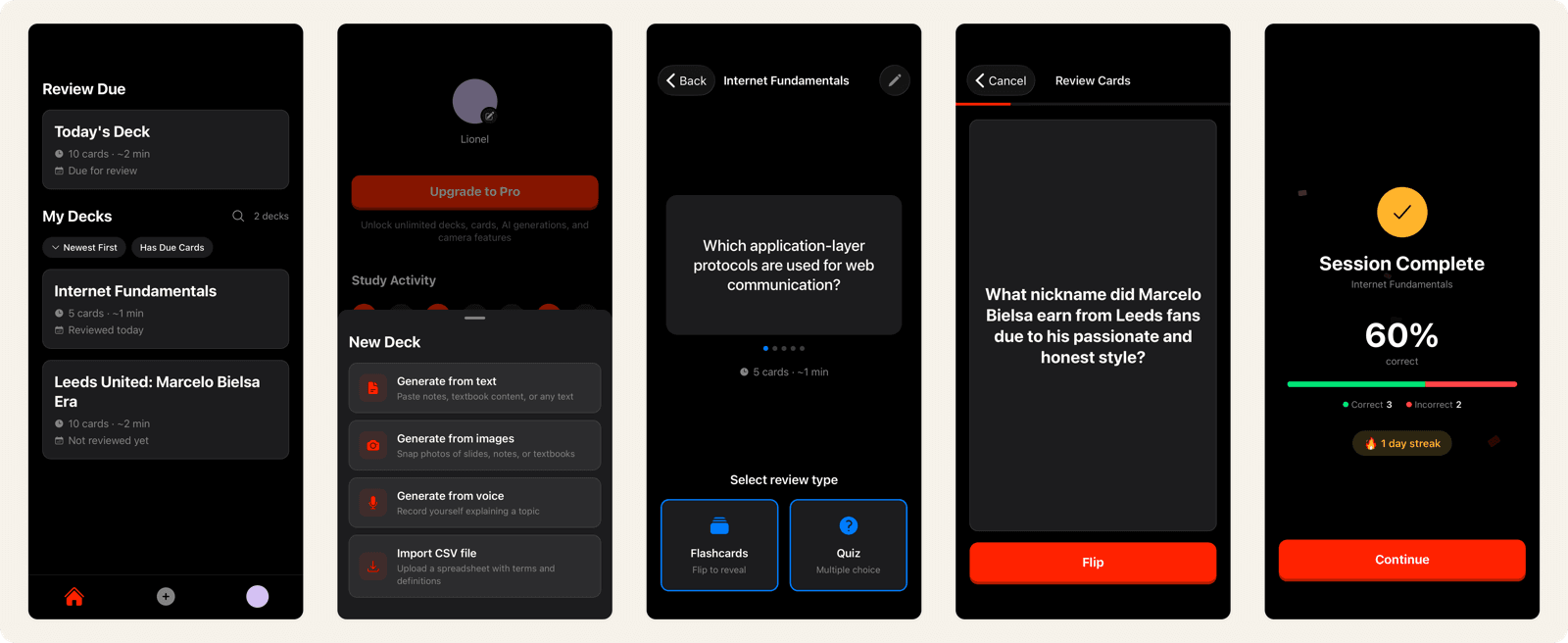
You keep your notes wherever they live — a physical notebook, Google Docs, Notion, a whiteboard — and use Sticky to bridge the gap between notes and studying. Photograph a page, paste a block of text, or dictate key points, and the AI generates flashcards in seconds. Sticky's SM-2 spaced repetition algorithm then schedules every review automatically. There is no knowledge graph to learn, no note structure to configure — just cards and a scientifically validated review schedule.
RemNote Features vs Sticky: Side-by-Side Comparison
Here is how RemNote and Sticky compare across the features that matter most for studying.
| Feature | RemNote | Sticky |
|---|---|---|
| Spaced repetition | SM-2 and FSRS algorithms | SM-2 algorithm, built into every review |
| Card creation | Inline from notes, AI generation (Pro) | AI from photos, text, and voice, plus CSV import |
| AI features | AI card gen, AI Tutor (Pro plan) | Photo to Card, Note to Card (included) |
| Note-taking | Full graph-based knowledge management | No |
| PDF annotation | Highlight, annotate, convert to cards | No |
| Card types | Q&A, cloze, image occlusion, lists | Front/back, AI-generated Q&A pairs |
| Platforms | Web, desktop, iOS, Android | iOS |
| Offline access | Desktop and mobile | No |
| Math & equations | KaTeX rendering, AI equation input | Full LaTeX rendering |
| Pricing | Free limited, Pro $8/mo annually | Free with premium options |
RemNote Spaced Repetition vs Sticky: Two Algorithms, Different Contexts
Both RemNote and Sticky use the SM-2 algorithm, which makes them more similar under the hood than most competitors. RemNote also offers FSRS as an alternative scheduler.
RemNote's spaced repetition is deeply integrated with its note-taking system. Flashcards live within your notes — they are not separate objects. When you review a card, you can immediately jump to the surrounding notes for context. This integration is powerful for subjects where understanding context matters as much as recalling individual facts.
Sticky's spaced repetition is the entire app experience. There is no note-taking layer — you create cards (manually or with AI), and the SM-2 algorithm schedules every review. The focus is on making daily reviews as quick and frictionless as possible.
The difference is philosophical. RemNote treats spaced repetition as one function within a larger knowledge management system. Sticky treats spaced repetition as the primary activity and optimises everything around it. Research consistently shows that spaced repetition combined with active recall is the most effective study technique available — the question is whether you want that embedded in a note-taking system or as a standalone experience.
If you are the kind of student who takes detailed, interconnected notes and wants your flashcards to emerge from that process, RemNote's integrated approach is elegant. If you want to snap a photo of your notes and start reviewing in seconds, Sticky removes the steps between having material and studying it.
RemNote Note-Taking vs Sticky: Knowledge Graph vs Camera-to-Card
This is the fundamental difference between the two apps.
RemNote is, at its core, a note-taking app with spaced repetition built in. Every note is a "Rem" — a node in a hierarchical knowledge graph that can be linked, referenced, and transcluded. You can annotate PDFs and have highlights flow directly into your notes and flashcard queue. You can create image occlusion cards from diagrams. The depth of the system is impressive.
That depth comes with a learning curve. RemNote's interface has concepts like Rems, portals, transclusion, hierarchical search, and multiple knowledge bases. New users often report spending weeks learning how to use the app effectively before they feel productive. For students who enjoy building systems, this investment pays off. For students who just want to study, it can feel like a barrier.
Sticky skips note-taking entirely and focuses on the bridge between your existing notes and active studying. The primary workflow is taking a photo of your study material — whatever format it is in — and letting AI convert it into flashcards. Your notes stay wherever you already take them: in a notebook, on a whiteboard, in Google Docs, in your textbook. Sticky's job is to turn that material into an effective study session.
The trade-off is genuine. RemNote's integration means your notes and flashcards are always in sync, and you build a comprehensive knowledge base over time. Sticky's separation means you can use any note-taking tool you prefer and still get spaced repetition benefits, with dramatically less setup time.
RemNote LaTeX vs Sticky: Math & Equation Support
This is one area where RemNote and Sticky are more similar than different — and where both stand apart from most competitors. Quizlet and Brainscape offer no native equation rendering at all. Anki supports MathJax but requires more setup. RemNote and Sticky both render equations natively, making them two of the best options for STEM students.
RemNote uses KaTeX for equation rendering, supporting both inline and block equations. It also offers an AI-assisted input feature where you can type a plain-text description like "integral of x squared from 0 to 3" and have it converted to LaTeX automatically. RemNote supports cloze deletions within equations, so you can test yourself on specific variables or terms inside a formula — a genuinely useful feature for studying derivations.
Sticky supports full LaTeX rendering on flashcards. You type LaTeX syntax and see properly formatted equations — fractions, integrals, Greek letters, matrices, chemical formulas. The rendering is clean and consistent across screen sizes.
The philosophical difference carries through here. RemNote's equation support is embedded in a full knowledge management system — your LaTeX equations live inside interconnected notes, alongside PDF annotations and linked concepts. Sticky's equation support is part of a focused flashcard experience — you create cards with equations and review them on a spaced repetition schedule, without the overhead of a note-taking platform.
Both apps handle the core job well. If you want equations within a comprehensive note-taking and flashcard system, RemNote's integration is elegant. If you want equation-capable flashcards with minimal setup time, Sticky delivers that without requiring you to learn a new note-taking system first. For tips on creating effective equation-based cards, see our guide to LaTeX math flashcards.
RemNote Pricing vs Sticky: What You Actually Pay
RemNote's free tier includes unlimited notes and flashcards with basic spaced repetition. But it caps PDF annotations at 3 documents and image occlusion at 5 cards — two features that many students consider essential for academic study.
RemNote pricing:
- Free: Limited PDF and image occlusion
- Pro: $10/month or $8/month annually (~$96/year)
- EDU discount: 25% off Pro with .edu email
- Life-Long Learner: $395 one-time
Sticky is free to download with core features included — AI card creation and SM-2 spaced repetition scheduling. There are no ads on any tier.
For students who need PDF annotation and image occlusion, RemNote Pro is a reasonable investment. For students who primarily study from lecture notes, handwritten pages, or textbook photos, Sticky's free AI card creation covers the most common workflow without a subscription.
Who Should Use RemNote
RemNote is a strong choice if:
- You want notes and flashcards in one place. If switching between a note-taking app and a flashcard app feels inefficient, RemNote's integration eliminates that context switch entirely.
- You study from PDFs extensively. RemNote's PDF annotation workflow — highlight, annotate, convert to cards — is well-suited for textbook-heavy subjects like medicine and law.
- You want FSRS scheduling. If you want a cutting-edge ML-based spaced repetition algorithm that adapts to your individual memory patterns, RemNote offers FSRS alongside SM-2.
- You enjoy building knowledge systems. If the idea of a graph-based knowledge base with linked, interconnected notes appeals to you, RemNote rewards that investment over time.
- You study on desktop. RemNote's desktop app is its strongest platform, with full feature access and offline support.
Who Should Use Sticky
Sticky is a strong choice if:
- You want to study your own material without learning a new system. Sticky does not require you to change how you take notes or learn a graph-based interface. Snap a photo, get cards, start reviewing.
- You want proven SM-2 spaced repetition without configuration. Sticky uses the same core algorithm as RemNote's SM-2 mode, with zero setup required.
- You prefer a clean, mobile-first experience. No knowledge graphs, no hierarchical search, no portals — just your cards and a review schedule.
- You already have a note-taking system you like. If you take notes in Google Docs, Notion, Apple Notes, or a physical notebook, Sticky works alongside your existing workflow instead of replacing it. It also offers curated decks for popular subjects like Anatomy & Physiology and AP Biology if you want a head start.
- You are new to spaced repetition. If you want effective flashcard study without a steep learning curve, Sticky is designed to get you studying in under a minute.
Is Sticky the Best RemNote Alternative?
RemNote and Sticky represent two fundamentally different approaches to spaced repetition. RemNote is a knowledge management system with spaced repetition embedded — it is powerful, deep, and rewards users who invest time building interconnected notes. Sticky is a focused flashcard app with AI card creation — it is fast, simple, and designed for students who want to spend their time studying, not configuring tools.
If you want your notes, PDFs, and flashcards in a single interconnected system and you are willing to learn a complex interface, RemNote delivers genuine depth. If you want to go from notes to studying in seconds and trust a proven algorithm to handle the scheduling, that is exactly what Sticky is built for.
The research on spaced repetition is clear: the best system is the one you actually use every day. For many students, that means the simplest one.
Still comparing options? See how Sticky stacks up against Anki, Quizlet, and Knowt, or explore more study guides and learning science to find the method that works best for you.