Quizlet is one of the most widely used study tools in the world. It has hundreds of millions of flashcard sets, multiple study modes, and a massive user base spanning middle school to medical school.
Sticky takes a different approach. Instead of being a broad study platform, it focuses on two things: using AI to create flashcards instantly from your notes, and using spaced repetition to schedule reviews for long-term retention.
Both are flashcard apps. But they solve different problems for different types of learners. Quizlet is best for students who want pre-made content and multiple study modes across any device. Sticky is best for students who want AI card creation from their own notes and true spaced repetition for long-term retention. This guide breaks down exactly how they compare.
Quick Verdict
you want access to millions of pre-made flashcard sets, multiple study modes like Match and Test, and a web-based platform you can use on any device.
you want AI to create flashcards from your own notes instantly, and you want a true spaced repetition algorithm that optimises your review schedule for long-term retention.
What Is Quizlet?
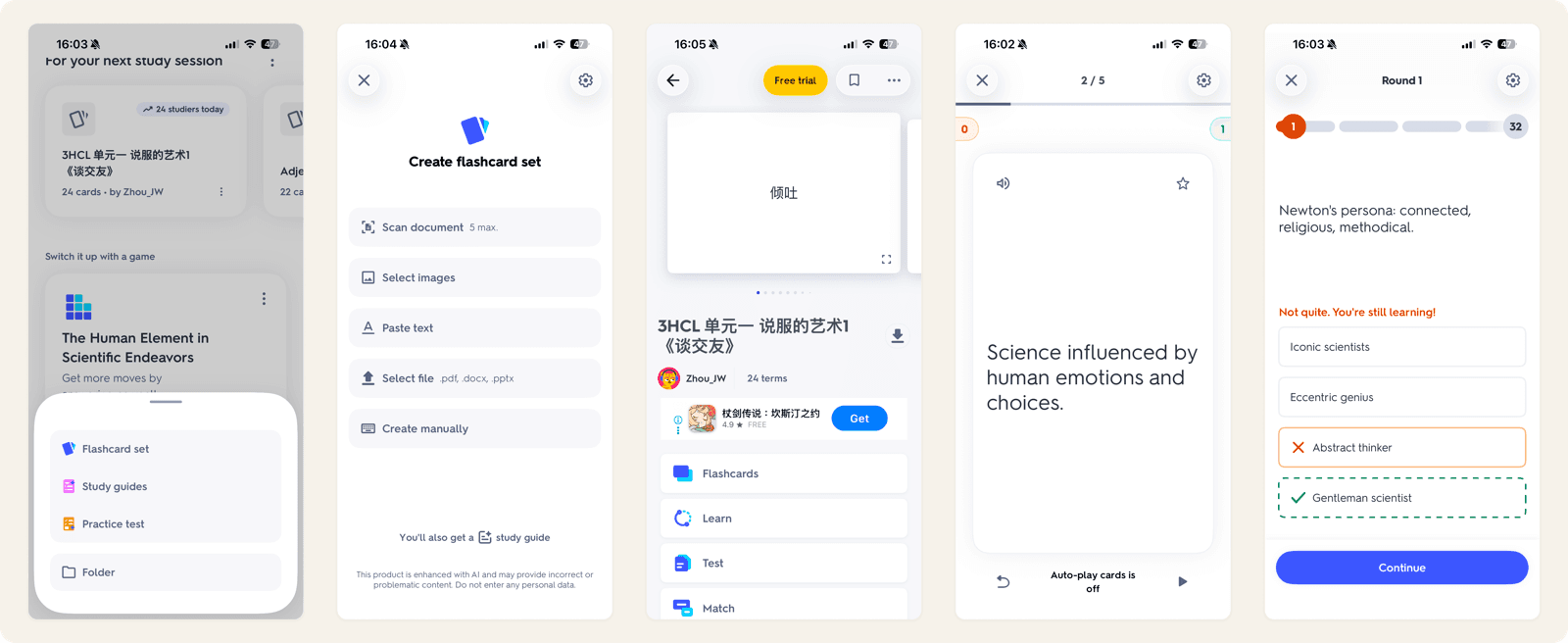
Quizlet is a web and mobile study platform built around user-created flashcard sets. Founded in 2005, it has grown into one of the largest education platforms in the world, with over 500 million flashcard sets created by its community.
The core experience is browsing or creating flashcard sets, then studying them through various modes: Flashcards (basic flip), Learn (adaptive questions), Test (practice exams), and Match (speed-matching game). Quizlet also offers Magic Notes, an AI feature that generates study materials from uploaded documents.
Quizlet operates on a freemium model. Basic flashcard creation and browsing are free, but key features like full Learn mode access, offline study, ad-free experience, and unlimited AI tools require Quizlet Plus at $35.99 per year.
What Is Sticky?
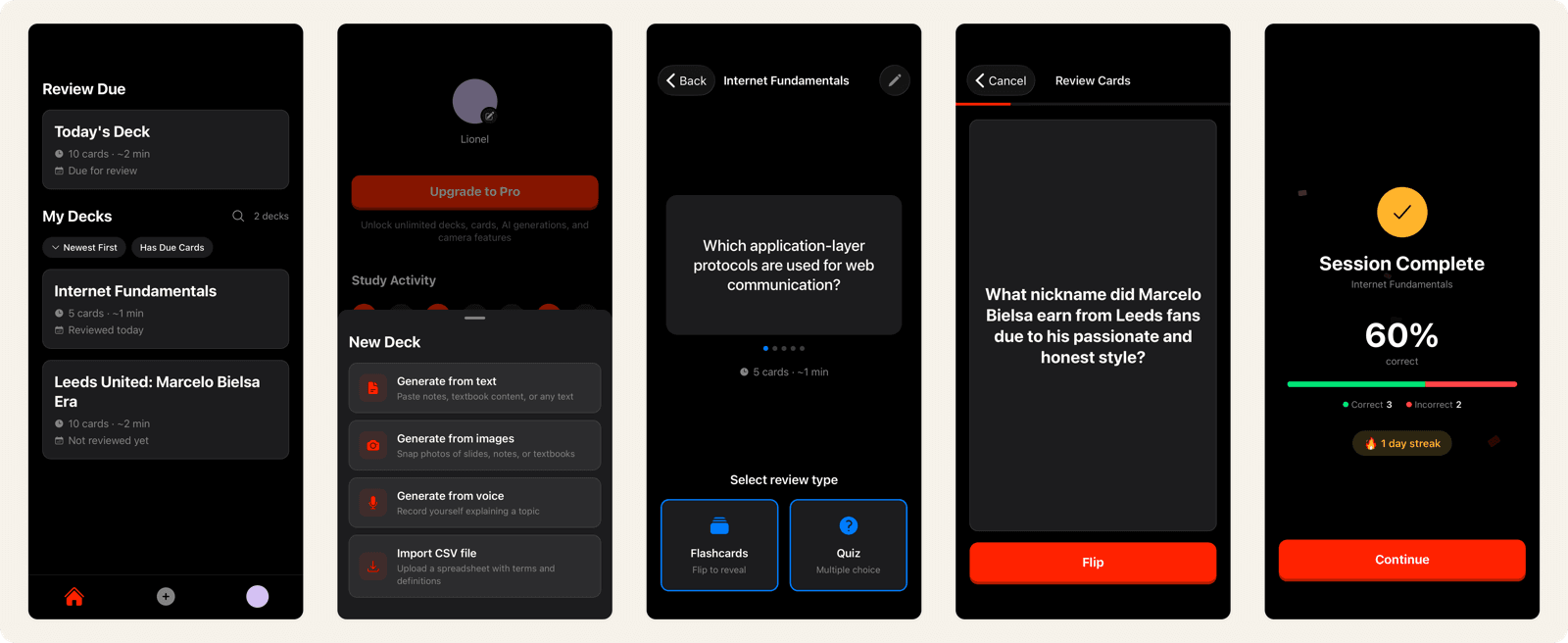
Sticky is an iOS flashcard app designed around two core ideas: AI-powered card creation and spaced repetition scheduling.
Instead of typing out flashcards manually or searching a library, you take a photo of your notes, textbook, or whiteboard and Sticky's AI generates a full deck of flashcards in seconds. You can also paste text directly using the Note to Card feature.
Once cards are created, Sticky's SM-2 spaced repetition algorithm takes over. It tracks your performance on every card individually and schedules reviews at expanding intervals, showing you cards right before you would forget them. The goal is not just passing your next exam but retaining knowledge long-term.
Quizlet Features vs Sticky: Side-by-Side Comparison
Here is how Quizlet and Sticky compare across the features that matter most for studying.
| Feature | Quizlet | Sticky |
|---|---|---|
| Card creation | Manual typing, import, AI via Magic Notes | AI from photos, text, and voice, plus CSV import |
| Spaced repetition | Adaptive algorithm (Learn mode, Plus only) | SM-2 algorithm, built into every review |
| AI features | Magic Notes (limited free, unlimited with Plus) | Photo to Card, Note to Card (included) |
| Study modes | Flashcards, Learn, Test, Match | Spaced repetition review, Quiz mode |
| Pre-made content | 500M+ community sets | Curated subject decks |
| Platforms | Web, iOS, Android | iOS |
| Offline access | Plus only | Yes |
| Math & equations | Basic symbol picker only | Full LaTeX rendering |
| Pricing | Free (limited) / $35.99 per year | Free with premium options |
| Ads | Yes (free tier) | No ads |
Quizlet Card Creation vs Sticky: Manual Entry vs AI from Your Notes
This is the biggest practical difference between the two apps.
With Quizlet, the traditional workflow is manual: you type a term on one side and a definition on the other, one card at a time. You can also import from spreadsheets or documents, and Quizlet's Magic Notes feature uses AI to generate cards from uploaded material. On the free tier, AI generation is limited.
Sticky's approach starts with AI. The primary card creation method is taking a photo of your study material and letting the AI extract key concepts and generate question-answer pairs. No typing, no formatting, no manual entry. You can also paste text and get the same result.
The difference matters most when you are working with your own material: lecture notes you just took, a textbook chapter you need to study, a whiteboard photo from class. Quizlet's strength is its library of content other people have already made. Sticky's strength is turning your specific material into cards instantly.
Quizlet Math & Equations vs Sticky: A Major Gap for STEM Students
If you study any subject that involves equations (physics, calculus, chemistry, engineering, statistics), this is one of the most important differences between the two apps.
Quizlet does not support LaTeX or any form of native equation rendering. It offers a basic math symbols picker that lets you insert common symbols like ± or √, but it cannot handle fractions, integrals, summation notation, subscripts for the full alphabet, or any of the notation that STEM students use daily. The only workaround is screenshotting equations from another tool and uploading them as images, which breaks searchability, makes cards impossible to edit, and looks inconsistent across different screen sizes.
This is one of the most common complaints from STEM students on Quizlet. Students studying organic chemistry cannot write reaction mechanisms. Physics students cannot write kinematic equations properly. Engineering students cannot format transfer functions. The symbol picker simply is not enough for serious scientific notation.
Sticky supports full LaTeX rendering on flashcards. You can type standard LaTeX syntax and see properly formatted equations: fractions, integrals, Greek letters, matrices, chemical formulas, and everything else you would write in a textbook. Your equations are native text, not screenshots, so they render cleanly on any screen size, remain searchable, and can be edited at any time.
For students in non-STEM subjects, this difference will not matter. But if your study material involves any kind of mathematical or scientific notation, it is a significant gap. You can learn more about creating equation-based cards in our guide to LaTeX math flashcards.
Quizlet Spaced Repetition vs Sticky: Adaptive Review vs Dedicated SRS
Spaced repetition is the study technique with the strongest evidence base in cognitive science. The idea is simple: review material at expanding intervals, right before you would forget it.
Quizlet's Learn mode uses an adaptive algorithm that incorporates spaced repetition principles. It varies question types and adjusts difficulty based on your responses. Notably, it asks for your test date and optimises the review schedule around that deadline. This makes it effective for short-term exam preparation. However, Learn mode requires Quizlet Plus for full access.
Sticky uses the SM-2 algorithm, a well-established spaced repetition system originally developed for SuperMemo. Every card is tracked individually. When you review a card and rate it Easy, Medium, or Hard, the algorithm calculates the optimal next review date. Cards you know well move to intervals of weeks, then months. Cards you struggle with stay on short intervals until you demonstrate mastery.
The key distinction: Quizlet's algorithm is designed around preparing for a specific exam date. Sticky's algorithm is designed around building durable, long-term memory. If you are studying for a test next week, both work. If you are building knowledge you need to retain for months or years (medical students, language learners, professional certifications), a dedicated SRS system has a meaningful advantage.
Quizlet Study Modes vs Sticky: Breadth vs Depth
Quizlet offers several study modes beyond basic flashcard review. Match turns your cards into a speed game. Test generates practice exams with multiple-choice, true/false, and written questions. Learn walks you through cards adaptively. These modes add variety and can make study sessions feel less repetitive.
Sticky focuses on two modes: spaced repetition review (the core study loop) and Quiz mode. Rather than offering many ways to interact with cards, it optimises the one method with the strongest evidence base: active recall through spaced retrieval practice.
This is a genuine trade-off. If you find variety keeps you motivated, Quizlet's multiple modes are an advantage. If you want every study minute optimised for retention, Sticky's focused approach is more efficient.
Quizlet Pre-Made Content vs Sticky: Library vs Your Own Material
Quizlet's biggest advantage is its content library. With hundreds of millions of user-created sets, there is probably already a deck for whatever you are studying. You can search for your textbook, course, or topic and start studying immediately without creating a single card.
Sticky takes a different approach. While it offers curated flashcard decks for popular subjects like AP Biology, SAT Math, and Spanish vocabulary, the primary workflow is creating cards from your own material. The AI card creation makes this fast enough that the advantage of pre-made content is smaller than it used to be.
There is a real value judgement here. Pre-made content is convenient but may not match your course exactly. Cards you create from your own notes (even with AI assistance) are more likely to cover exactly what your professor emphasises. Research on effective flashcard design suggests that engagement with the material during card creation itself aids learning.
Quizlet Pricing vs Sticky: What You Actually Pay
Quizlet's free tier gives you basic flashcard creation, community set browsing, and limited access to study modes. To unlock full Learn mode, Test mode, offline access, ad removal, and unlimited AI features, you need Quizlet Plus at $35.99 per year ($7.99 monthly).
Sticky is free to download with core features included. There are no ads on any tier. AI card creation and spaced repetition scheduling are available without a subscription.
Who Should Use Quizlet
Quizlet is a strong choice if:
- You want pre-made content. If you would rather search for existing flashcard sets than create your own, Quizlet's massive library is unmatched.
- You study on the web. Quizlet works in any browser, making it accessible on school computers, Chromebooks, and any device. Sticky is currently iOS only.
- You like variety in study modes. Match, Test, and Learn modes offer different ways to engage with your material and can reduce study fatigue.
- You are preparing for a specific exam. Quizlet's deadline-aware algorithm is designed around test preparation, and the community likely has sets for your exact course.
Who Should Use Sticky
Sticky is a strong choice if:
- You want to study your own material efficiently. If you have lecture notes, textbook pages, or handwritten notes, Sticky turns them into flashcards in seconds with AI.
- You need long-term retention. For subjects where you need to remember material for months or years (medicine, languages, professional exams), Sticky's SM-2 algorithm is purpose-built for durable memory.
- You prefer a focused, distraction-free experience. No ads, no gamified modes, no social features. Just your cards and an algorithm that tells you what to study and when.
- You are an iOS user who studies on mobile. Sticky is designed as a mobile-first experience, with the camera-to-card workflow built around how students actually capture information.
Is Sticky the Best Quizlet Alternative?
Quizlet and Sticky are both flashcard apps, but they are optimised for different things. Quizlet is a broad study platform with a massive content library and multiple study modes. Sticky is a focused learning tool built around AI card creation and spaced repetition.
If you want to browse existing flashcard sets and use a variety of study modes across any device, Quizlet does that well.
If you want to turn your own notes into flashcards instantly and have an evidence-based algorithm schedule your reviews for long-term retention, that is exactly what Sticky is built for.
The best choice depends on how you study. Many students use both: Quizlet for quick access to community content, and Sticky for the material they need to truly master. Curious how Sticky fares against the newer AI flashcard apps? See our Sticky vs Gizmo comparison, or explore more study guides and learning science to find the approach that works best for you.